Bay Area Market Adjusts to Life After Tech Boom

For the first time in years, there appear to be some real estate deals in the San Francisco Bay area market for apparel industry resources, but the question is, can anyone take advantage of them?
After receiving the ultimate one-two punch last year by way of a crashing tech sector and repercussions from the events of Sept. 11, Bay area retailers and manufacturers including Gap Inc. and Levi Strauss & Co. got hit hard and are now closing plants and trimming expenses. Real estate is also feeling the effects, especially in the commercial sector, as rents for office space are around half of what they were a couple of years ago.
Retailers, especially those who rely on out-of-town traffic for sales, have seen sales fall 10 percent to 20 percent, and rents have reflected the drop, falling at a similar rate, say real estate executives. The drop in travel seen after Sept. 11 has not reversed and that has particularly hurt San Francisco. Roughly 80 percent of traffic in the city is generated from out-of-towners, according to economist Jack Kyser of the Los Angeles County Economic Development Corp., who surveys economic conditions statewide for the organization. Kyser said everyone from Market Street to Haight/Ashbury has felt the pinch.
“The questions now are how long will it be before all the international travel returns and when the tech industry will recover. We’re probably looking at 2003 when that happens. If you’re a bottom-fisher, it may be a good time to rent or buy [real estate] or start looking,” said Kyser.
Seth Nodelman, director of retail services for Cushman & Wakefield in the Union Square area of San Francisco, said he didn’t see anyone looking for retail space between Sept. 11 and the beginning of this year.
“It’s starting to change. We’re seeing some European retailers scouting around. The good news is that it’s not getting worse,” he said.
Economic indicators back that up to a degree. Unemployment improved for the first time in months in April, dropping to 5.2 percent from 5.4 percent.
“You’re still looking at 36,000 non-farm jobs lost over the past year and another 64,000 lost in San Jose [Calif.],” said Kyser, who also said he thinks the worst is over. Other indicators are in accord. The Bay Area Business Confidence Index, which surveys executives of area companies, registered a 25 percent increase, jumping from 51 points in January to 64 in April.
“By no means are things back to normal,” said Union Square retailer Ken Vais of Mix, a high-end women’s boutique. “Everybody took their hits and some did better than others, but this market has been somewhat insulated [by rent drops]. There are always takers because there are so few key choices here.”
While drops in retail space rents in San Francisco haven’t approached the rent drops that office space has experienced over the past year, they have paralleled drops in store sales of 10 percent to 20 percent, said Nodelman.
“But even in locations around Post and Stockton streets, you’re almost seeing bidding wars for the best space,” he said. But, he added, there are deals in the environs that are probably more suitable for retailers who need parking space.
In San Francisco, some big brands aremaintaining an active stance. Diesel, which has a store on Post Street, reportedly is scouting for expansion sites. Levi Strauss & Co. is overhauling its 24,000-square-foot flagship store in Union Square, hoping to improve sales by as much as 30 percent with more space and a consumer-friendly shopping layout.
Levi’s has also announced plans to shutter its nearly 100-year-old Valencia Street plant this summer as part of its shift away from owner-operated production. It will close five other factories across the country. The Valencia factory may become a museum, officials said, while the original factory in San Francisco remains in operation. Levi’s isn’t the only one trimming the fat. Esprit de Corp. has closed its Minnesota Street headquarters and Illinois Street outlet store, while struggling Gap is shuffling its real estate assets around, subleasing some of its properties.
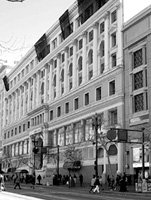
One of the most ambitious projects right now in the city is Forest City Enterprises’ redevelopment of the old Emporium building on Market Street into a 350,000-square-foot hotel/retail center with a new Bloomingdale’s to anchor. This project currently is mired in litigation over preservation issues, but Forest City representatives said they hope to emerge from the litigation this summer and proceed with development plans.
The Bloomingdale’s project, said Nodelman, could be a big shot in the arm for downtown commerce, but some other parties that signed letters of intent for the project have since looked elsewhere for space, he said.
Beyond the aforementioned in-town activity, there are other projects emerging in the city and outlying areas. Off-price specialist Mills Corp., known for Ontario Mills and other entertainment-based shopping centers, has reached a tentative lease agreement with the Port of San Francisco to develop Piers 27–31 along the city’s northeast waterfront into a retail/office/recreation center with plans to open in 2006. There’s lots of support for this project since Mills is building a new YMCA as part of the development.
In nearby Santa Clara County, developers are looking to pump new life into aging retail centers. San Jose’s Eastridge Mall is being eyed by developer General Growth Properties for a $90 million facelift that would rebuild the 1970s-era center into a modern destination center featuring an outdoor promenade with theaters and 144,000 square feet of street retail.
Westfield Corp. Inc., which owns Westfield Shoppingtown Valley Fair in Santa Clara and Westfield Oakridge in San Jose, has spent $150 million to expand the former from about 1.1 million square feet to more than 1.5 million square feet in recent years. The company expects to start on a 250,000-square-foot addition to its Oakridge center, including a new theater, soon.
Outside of retail property, Bay area apparel industry sources are looking at Southern California for opportunities as the design and logistics base grows in Los Angeles. Brisbane, Calif.-based Bebe recently shifted its chief executive officer and its design and production team to Los Angeles, where it’s leasing 15,000 square feet at the Cooper Building in the downtown fashion district. And Ross Stores, the Newark, Calif.-based discount retailer, is moving 800 jobs out of its headquarters next year and shifting them to Southern California, where the company is building a 1.3 million-square-foot center in the Inland Empire.
“It makes better sense with [the center] being closer to the Port of Long Beach, where most of our shipments arrive,” said Ross spokeswoman Katie Loughnot. The Newark employees will have the option of transferring to Southern California at the same pay level next year, Loughnot said.
Kyser said the shift from Northern California to the south isn’t all accidental, citing strong apparel industry employment in markets such as Orange County, where sportswear and beachwear/surfwear have held their own. The tech fallout in the Bay area/Silicon Valley priced a lot of players out of the market, but Kyser sees the real estate pricing shift as a “bubble” that should eventually correct itself and retailers are hoping that happens soon.