New Lines, New Programs at WCE's Los Angeles Show
Los Angeles–based menswear show Westcoast Exclusive hosted its Aug. 3–5 show at the W Hotel in the Westwood section of Los Angeles. The exhibitor list included established brands as well as new-to-the-show lines. The show also held its first seminar in a planned seminar series covering menswear retail and distribution issues.
Organizers said there were 40 exhibitors showing nearly 100 lines and about 130 retailers attending the show, including buyers from Fred Segal Santa Monica, Ron Herman at Fred Segal Melrose, Mario’s, Barneys, Patrick James, Global 61, Patrick Reed and Nordstrom stores.
As always, the biannual show drew upscale menswear buyers from the West Coast. In past seasons, the show’s turnout had been predominantly made up of California retailers. But more buyers traveled from farther away to attend the recent show, organizers said.
“We have seen a resurgence of retailers from different parts of the West Coast,” said Larry Hymes, one of the show’s organizers. Hymes said buyers came from as far north as Seattle and as far east as New Mexico.
Last year, Westcoast Exclusive launched a second show in the Rio All-Suite Hotel & Casino in Las Vegas that ran concurrently with MAGIC International. Hymes said there was some concern among exhibitors and attendees that the Las Vegas show would overshadow the Los Angeles show. But, he said, the recent turnout proved that the Los Angeles show is still an important venue for retailers.
“The feeling is that we see there is definitely a need for this show in L.A.,” Hymes said. “As we’re growing in Las Vegas, the concern is for what is happening for this [Los Angeles] show, and it’s only going to keep growing.”
One thing that could change is the location.
“We’re going to evaluate what to do as far as the venue,” Hymes said.
Organizers have held the show in the same location since its launch five years ago. (Back then, the hotel was the Westwood Marquis.) The show is held on several floors of the upscale, trendy W Hotel.
For this run of the show, returning exhibitors Jhane Barnes, Tommy Bahama, Haupt and Avirex were joined by newcomers FRX Clothing, Mod-O-Doc, 3 Dots, Lambretta, Felix, Zuki International and Tassio.
The show is expanding its focus to include categories such as contemporary menswear.
“We want to bring in a younger audience,” Hymes said. “We know we have to get more directional lines.” He said some of the more fashion-focused labels in the show included 4 You, Max Musina, NYBased and Ted Baker.
This was the first time at the show for Michael Ryan, a rep with the Blue Agency in New York. The Blue Agency represents four lines: Felix, a British line of wovens that retails for under $100; Lambretta, a British sportswear collection based on the Mod scooter scene; Napapijri, an Italian line of technical sportswear; and 3 Dots, the men’s line extension of the Los Angeles–based contemporary women’s label.
Ryan said he found several new leads with promising retailers.
“I like the caliber of retailer [at the show]—lots of good, solid, A accounts,” he said, noting that his lines sell in better specialty stores and a few larger upscale retailers such as Saks Fifth Avenue.
This was the second time at the show for Kevin Spencer, a rep for Los Angeles–based contemporary men’s line Ben Ryan. Spencer shared a space with Paul Stork, who reps NYBased and Itsus. The two also have permanent showroom space in The New Mart and attend MAGIC International.
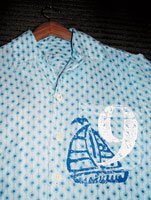
The Ben Ryan collection, which sells in specialty boutiques and in Barneys in Japan, has an edgy, contemporary look. T-shirts and woven shirts have raw edges and screen-printed graphics. The denim and corduroy pants have unusual pocket and waistband treatments and come in a range of washes. Wholesale prices range from $14 for a T-shirt to $44 for denim with specialty washes.
Spencer said he met with some new accounts at the show that he would not have met with in his New Mart showroom. He said he was planning to keep his downtown showroom, where he typically meets with retailers that carry both men’s and women’s apparel, open during the Aug. 8–12 run of Los Angeles Market Week.
“A couple of stores today [at Westcoast Exclusive] said they’re getting a younger customer—and they’re trying to carry clothing for both [the new younger customer and their existing client base],” he said.
The first day of the recent show was stronger than the first day of the show last year, according to Steve Mandelbaum, who added that he booked more appointments on the second day.
Mandelbaum has participated in the Westcoast Exclusive’s Los Angeles show since its launch and also attends at the Las Vegas event. He said he has seen changes in traffic since the launch of the Las Vegas show, as retailers choose one show over the other or opt to spend less time at the Los Angeles show.
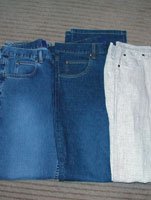
Mandelbaum was showing three lines: Options Unlimited, a Hong Kong–made collection of woven shirts with European fabrics, jeans and T-shirts; White Shirt Blue Jeans, a casual line that started as basics but has expanded to include more fashion-focused styles and fabrics; and Autumn Cashmere’s cotton line, which is made in China from Italian yarns.
The three lines sell primarily in specialty stores, Mandelbaum said, adding that he also does some business with Nordstrom.
Returning retailers
Retailer Doug Champaign has been coming to the Los Angeles Westcoast Exclusive since its inception and also stops by the Las Vegas show. Champaign—who looked for Spring items for his store, Mario’s, in St. Helena, Calif.—praised the show for its exhibitors and amenities.
“It’s one of the best-put-together shows I’ve ever experienced as far as the quality—and the fact that they feed you,” he said, noting that the show provides retailers with complimentary breakfasts and lunches.
Champaign said he typically spends three days shopping the show and then returns home to fax in his orders.
Another frequent attendee is Ian Stewart Daniels, owner of Planet Americana in Santa Monica, Calif.
Daniels said he attends several trade shows—both to shop and to see new trends in different categories.
“This is a dressier category than what I’m doing, but I feel it’s important to see things,” he said. “A lot of times the casual lines are influenced by the dressier lines.”
And Daniels said he does find new resources at the show—some lines that are new to the show, some that have a new look and others that are simply new to him.
“Once in a while my eye changes—or maybe it was here before and I missed it, or sometimes the line changes,” he said.
Talking business
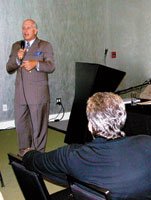
Westcoast Exclusive hosted its first seminar, titled “Being Proactive in Uncertain Times,” at the show.
The panel discussion, hosted by motivational speaker Dr. Jack Singer, featured Michel Himy, a designer, manufacturer, merchandiser and retailer of the Harry O label; retailer Glenn Laiken, owner of Culver City, Calif.–based Alandales; Terry Miller Katana, apparel trend analyst and former creative merchandising director for buying office Arkin California; and Jim Watterson, former vice president of public relations and special events for Robinsons-May department stores.
“You have a big challenge in this market,” said Watterson, who opened the discussion. “Being involved in your community, being involved with your customer is important.”
Laiken, who got his start in retail in 1968 with a unisex jeans store called Glen Laiken Pants, underscored the importance of community involvement. Laiken serves as the vice chairman of the Culver City Chamber of Commerce and sits on the board of the Downtown Business Association.
“You automatically network yourself by being involved,” he said. “The credibility comes through your relationship with the community.”
The panelists stressed the importance of customer service—particularly for male consumers.
“The male consumer is different from the female consumer—you have to give the male consumer perceived value,” Laiken said.
The panel had the following recommendations for creating perceived value and improving customer service:
bull; Add private-label apparel to the merchandise mix. Laiken described the benefit of private-label merchandise as “an insulating factor to enable us to absorb markdowns.”
bull; Find a direct marketing connection to the consumer. Laiken said he has been very successful with direct cable advertising. He also recommended that companies gather customers’ e-mail addresses and send them digital images of new merchandise with personalized messages.
bull; Offer something for nothing. Himy regularly sends out cards offering a free tie to anyone who comes into the store with the card. He said he does not require customers to make a purchase—although most do—and he said retailers can stash the expensive ties in the backroom during the promotion. “The consumer likes to be given something,” he said.
bull; Wine and dine customers. Himy said he regularly takes good customers out to dinner. “You’ve got to keep your client entertained— a client wants to feel important,” he said. He also recommended that all retailers invest in a cappuccino maker. He said being able to offer customers espresso is a great way to break the ice when they enter the store.
bull; Shop the entire market. “One thing I’ve learned as a retailer is to look at every line every time you have an opportunity,” Himy said. “You can tell in 45 seconds if it’s not for you.”
bull; Know who you are. “The store must return back to having an identity,” Laiken said. “These stores that rely on branded apparel will always battle with the large stores. When the consumer walks in the store, they feel the personality. [Large] stores become warehouses for manufacturers. The specialty stores must have that personality.”
The panelists noted that customers are changing and retailers need to adapt to new younger consumers, who have different shopping habits and senses of style.
“We now are in tough retailing times,” Katana said. “We’ve been there before, but now we have a whole new generation.”
The panel agreed that specialty stores that adapt to the new generation stand the best chance of surviving against larger retailers with more buying power and the financial ability to run back-to-back sales.
“It’s no question that we’re all under attack from department stores, but department stores are a sea of sameness,” said Katana. “What the Gap and Hot Topic and Pacific Sunwear and Anchor Blue all do that works brilliantly to bring customers in is they all have relatable, generational sales associates. It all starts with Wal-Mart and their seniorcitizen greeter. There’s a reason why they’re the number-one retailer.”
Himy also recommended retailers bring a savvy buyer or sales associate along on buying trips.
“You have to be able to let new blood in,” he said.
In all, the panel was optimistic and noted that specialty-store retailers are in a strong position to attract consumers looking for better customer service and a more personalized shopping experience.
“Here we are at the dawning of the era of the return of street shopping,” Katana said. “People want a point of difference because there are no must-haves at the department stores. The specialty store is the last line of service.”
Among the retailers in the audience was On Beverly owner Shauna Stein. Stein, who carries only women’s apparel in her store, heard about the seminar from her husband, who works in the menswear business.
“You have to reach out today to take advantage of any bit of information that’s out there,” she said. “This industry is in such flux—we all need to know how to move forward. It’s comforting to know you’re in really good company with the challenges.”
Organizers said they hope to host similar seminars at future shows and are asking retailers to offer topic suggestions.