Bella+Canvas
TRADE SHOW REPORT
Impressions Expo Goes Beyond the Basic Blank
The Jan. 21–24 edition of Impressions Expo in Long Beach, Calif., reflected an industry evolving beyond “basic blanks” toward premium foundations, vertically integrated manufacturing and decoration technologies that enable speed and customization.
Next Level Apparel, with production in Central America and a transition toward exclusively U.S.-sourced cotton, is a premium-style blanks apparel company serving decorators, promotional-product distributors and retail brands. “The company’s focus is to elevate blanks beyond basics into fashion-forward essentials,” emphasized account executive Michael Brennan.
American Apparel highlighted its Fine Jersey Collection as a core product line, with the 1301 tee remaining its top-selling style. Garments are produced in Central America and Bangladesh using U.S. cotton. Georgia Stone, brand specialist, noted that “music companies and lifestyle brands continue to drive demand for affordable, recognizable styles.”
LA Apparel differentiates itself through complete vertical integration at its South Los Angeles factory. All cutting, sewing and distribution occur on-site, with woven pieces and 100 percent cotton garments representing top sellers. Heavyweight and oversized tees remain strong trends, while lighter, more-fitted silhouettes are also gaining traction.
US Blanks in Vernon, Calif., produces 100 percent U.S.-made garments with custom-dye and -print capabilities. “Our value proposition centers on domestic production and customization flexibility,” said account executive Lisa Davidson. The brand serves high-end retailers and music-merchandise companies, offering sustainable options such as organic cotton jerseys.
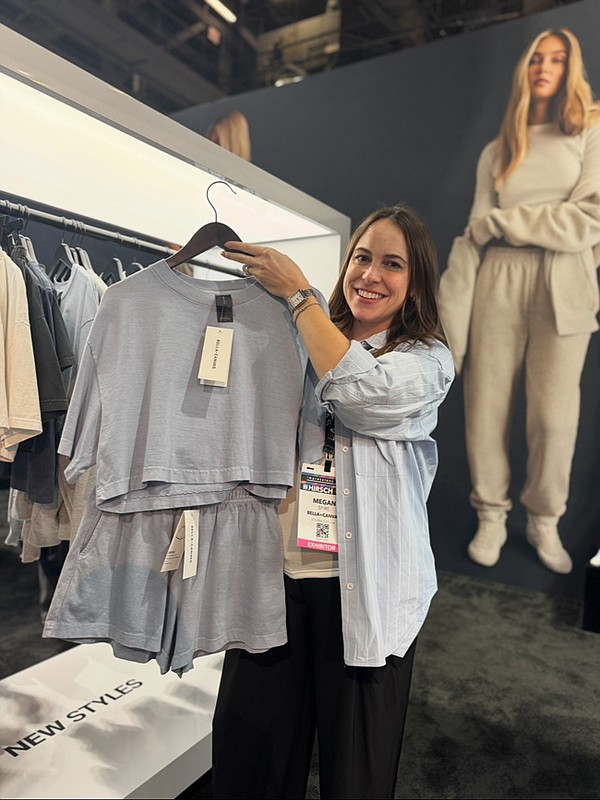
Bella+Canvas sources fabric internationally, assembles it in Central America and dyes it in Los Angeles. The company manufactures blanks exclusively for wholesale B2B customers and offers more than 300 colors. “Our blank is the blueprint,” explained VP of Sales and Marketing Megan Spire. Bella+Canvas encourages creating fully private-label products.
USA Standard Apparel offers private-label programs and blank collections built on vintage-inspired aesthetics. The company knits its own fabrics in-house, outsourcing only garment dyeing. “Quality and reliability separate us,” said CEO Sean Sassounian. Top styles include rocker tees and cropped rocker tees, widely used for music merchandise.
Supacolor presented heat transfers not as a one-size-fits-all solution but as a customizable system designed for diverse garment types and production environments. It specializes in apparel adhesives, inks, powders and transfer media engineered for durability. “The ink and glue don’t fade or scratch,” explained commercial director Haziel Mitchell. Supacolor serves primarily B2B clients such as contract decorators and sports-uniform producers.
Epson showcased its newest roll-to-roll DTF printer, the SureColor G9070, designed for high-speed production. “We pride ourselves on reliability, quality and consistency, especially when it comes to color and high-fidelity detail,” said product manager Paul Morales. Epson’s customers include apparel decorators, high-volume transfer facilities and small businesses using earlier-generation machines.
Mimaki highlighted its TxF300-75 sustainable-fabric printing solution. The printer is 32 inches wide and can print skin-friendly textiles. “We have a mission to help small businesses grow and large businesses increase production,” said training and applications supervisor Carissa Terwey. The company supports apparel brands and print labs.
Kornit offers entry-level systems to platforms capable of printing 400 shirts per hour. Its low-temperature curing inks allow printing on blends without dye migration. “We’re seeing strong adoption because major brands need solutions that combine speed, reliability and print quality at scale,” said Ilan Elad, president of the Americas at Kornit Digital.
As brands increasingly treat blanks as brand foundations and technology as growth infrastructure, the industry continues to shift toward higher-value, higher-margin B2B solutions.