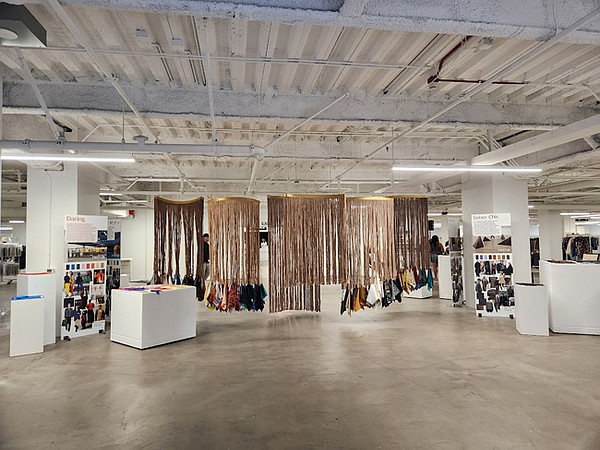
LA Textile relied on a show formula that blended trend installations, casual networking opportunities and educational discussions. From left, the Trend Forum
LA TEXTILE
LA Textile Brings Trends in Fabric and Technology to the Forefront
Downtown Los Angeles’ California Market Center hosted its semiannual LA Textile event Sept. 29–Oct. 1. Fashion creatives attended the show to explore trends in fabrics, supply chain and manufacturing for Fall/Winter ’27–’28.
Show producers brought together a range of exhibitors to meet the needs of brands at every stage. Offerings also included a daily seminar schedule to cover many of the most-pressing issues facing the fashion industry today. Top of mind for many was the growing influence of artificial intelligence. The show also featured its “Trend Forum,” which is often created for every edition of LA Textile to showcase the latest in color, texture and fabrication.
Beyond business, LA Textile featured a complimentary espresso and tea bar. German silk maker Barth & Könenkamp Seiden hosted a happy hour each day of the show. Kitchen Bann served Korean cuisine for purchase at the lunch café.
A beautiful day in the neighborhoods
To simplify the visitor experience during LA Textile, show producers created different neighborhoods where attendees were able to easily locate resources. Different neighborhoods included Made In Japan and the Turkish Textile Pavilion in addition to Sustainable Knit, Denim & Functional Fabrics and Premium Fabric Collections.
Robert McAuley, who works in sales and product development at Vernon, Calif.’s SAS Textiles, welcomed visitors to his booth in the Sustainable Knit, Denim & Functional Fabrics neighborhood.
“If you’re looking to source in the USA, you have to know exactly the supplier you’re dealing with and where they’re making it. Is the clothing ethically produced? Is there a living wage involved? Accountability is important,” said McAuley. “Traceability of the product. Where did the yarn come from? Who knitted it? Who stands by the quality? Who can repeat that quality?”
The message of responsible sourcing also resonated with Franky Tran, a designer who specializes in custom occasion pieces. Sustainability requires a different approach when working in formalwear or luxury so Tran focuses on using heirloom-grade fabrics.
“I try to do things that make sense, from a business perspective and being resourceful. I am mindful of the quality and intention. I intentionally keep my practice small, intimate and commission based. Waste not, want not,” said Tran.
LP Monte, designer and founder of handmade streetwear brand Band Runnaz Clothing and a fashion-merchandising student at Los Angeles Trade-Technical College searched for inspiration to spark his next collection.
“I was especially interested in technical fabrics for winter wear, including waterproof materials, insulated fabrics and anything innovative that could elevate my designs,” said Monte. “There’s a growing need for more-innovative textiles that combine fashion, functionality and sustainability, especially as streetwear continues to evolve.”
Talking about trends and tech
The “Panels & Talks” schedule included discussions covering trends coming down the pike, such as “Disobedience”: FW27/28 trend direction by NellyRodi Paris” with Jacqueline Rumohr and “The New Aesthetic for FW 27/28—Myth, Mess & Mastery: The New Language of Design,” a trend presentation by Jennifer Karuletwa, managing director of North America for Peclers Paris.
Conversations during LA Textile turned to technology, particularly AI. Tech show topics included a “Fireside Chat: AI Isn’t About Replacing Creativity. It’s About Amplifying It” with Natalie de Groot of The Fashion Aigency and Tirsa Parrish of Fashion Index, who wants to educate creatives and dispel fears surrounding rumors of AI eliminating the need for jobs performed by humans.
“You need to start using tech now. The ones who are going to be replaced are the ones who don’t use it, and they’re going to be replaced by the ones who do,” Parrish said. “We have to meet the audience where they are. There is a lot of fear that is causing paralysis. We need to get them beyond the paralysis to start engaging.”
At the booth for Tech Pack Tailor, an online technical design and fashion tool headquartered in Los Angeles, founder Lauren Dorsey noted that AI can support creatives in the industry if it is used correctly.
“It seems people are either fearful of it 100 percent and don’t want to touch it or they see the benefit of it,” explained Dorsey. “The creative component is the part that people really get stuck on. They feel it’s going to take away creativity, but it just depends on how you use it. It can be a good assistant, but it can’t do everything.”
Kristina McConnico, owner of the Bay Area womenswear brand Lacson Ravello visited LA Textile to search for print and color direction but also prioritized sitting in on Parrish and de Groot’s discussion.
“AI is so hot right now. If you’re not in it, you’re missing out,” noted McConnico, who has worked in the fashion industry for 30 years. “This show is more than textiles and fabric. There is so much industry knowledge, from going to the seminars and trend forecasting, vendor relationships, manufacturing, product development, and, of course, technology and AI. That’s why I love to come to this event. You learn so much.”