The Seminar Circuit
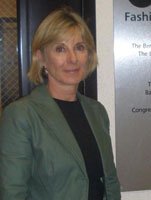

The Doneger Group has been around so long—just about 60 years—you figure there isn’t a lot the company hasn’t seen. Once a buying office, The Doneger Group has morphed way beyond its origins to become one of the premier fashion forecasting and trend-spotting analysts in the industry. Its main business is to gather in the vast array of fashion creativity generated around the world, synthesize it into recognizable and saleable trends, report same to clients, and, as West Coast division manager and veteran trend-spotter Janine Blaine explains, “interpret the information for the particular client to make it marketable for them and their consumers.” The Doneger Group’s reputation, however, is not only built on the services it provides its clients but also on the public-welcome seminars it offers, both in its offices and at major trade shows and conventions.
The seminar program works around a series of creative directors. Pat Tunsky does color and fabric direction, Jamie Ross juniors and kids, Christian Gilbert runway, Amanda Hallay the European scene. The dean of the group is David Wolfe, in the business since 1959, in fashion forecasting since 1969. So perceptive is his insight that private client-specific research presentations by Wolfe can run $20,000. He is Doneger’s Big Picture guy, a self-described “frustrated stand-up comic/actor.”
“My presentations are a little bit different,” Wolfe says. “I’m very parental about the industry, almost evangelical. I provide inspiration and information, but what makes my gig a bit special is I’m focused on entertainment and humor to keep people awake. I love shocking, funny images, always with a point to help them understand where fashion is going astray.”Wolfe averages six to eight presentations a month, some for clients only, some for the general public. These are 30-to-45-minute PowerPoint sessions, which give attendees a picture-perfect, easy-to-digest guide to the future. He does seasonal presentations, an exhausting three times daily for three days in his New York office for clients and the paying public at $50 a head. At MAGIC International, Wolfe will do five—“different ones for different audiences”—that are free to MAGIC attendees. He also travels the country and the world for special presentations, such as at the new print resource show, Prelude, which bowed this year at the California Market Center.
The year 2006, however, is old news to Wolfe; currently he’s way into 2007. Even as he finds the new, there is the note of constancy, “the old-fashioned pendulum,” Wolfe says. “The trick is to figure out how fast it is swinging.” A student of fashion history, he looks for “influences that are big enough to affect a whole lot of merchandise. Politics, economics, show biz, demographics, scandals—all things that affect how people want to present themselves.” He also takes on topics “for the fun of it.” “Fads and Foibles of 20th Century Fashion” is one of those, another is on the art of timing, “encouraging people to get timing more specific to their market.”Wolfe’s wisdoms—the things that make his presentations standing room only events—often go beyond the ephemeral. “Really, mega-movements aren’t seasonal,” he says. “They take a long time to come in and a long time to die. Fashion is an evolutionary process they need to understand. They have to study mistakes or they are doomed to repeat them.”
The ABCs of FBI
All the creativity in the world isn’t enough to put together a successful fashion business. That’s a lesson Frances Harder learned the hard way when she made her first forays into the apparel business. But it was only while teaching at the Otis College of Art + Design, fielding nonstop questions on how you go about starting up a business, that she began to realize how large the gap was. “You see so many of these creative young people, and within a year they are out of business,” she says. “They are so totally unprepared. Only 2 percent of being successful is the design part.”Harder realized something else: It would be her particular vocation to offer information, education, and advice to the apparel industry, soliciting grants to cover the overhead and experts to lead the seminars. And so began FBI—Fashion Business Incorporated, an educational nonprofit institution that offers its members industry-specific business and compliance education, sourcing, networking, marketing and consulting services.
“We are an industry-specific business development center,” she says. “There aren’t many of those around.” Ensconced in a 4,800-square-foot donated space in The New Mart in downtown Los Angeles, built out by the Department of Water and Power for free, FBI has raised city and state grant money, plus innumerable donations of industry expert services. “So many people have helped us, it’s been very special,” she says.
FBI is about continuing education through the seminar format. To that end, FBI offers an average two seminars per week, more than 100 a year; at the recent Los Angeles International Textile Show, FBI sponsored 13 free hour-long seminars. Generally, members, who ante up $200 per year for a slew of services and benefits, pay $40 for a three-hour seminar and nonmembers pay $50. Recent offerings have included classes on recruiting and developing a sales team, retailing for profit, costing for profit, how to figure out if your business strategy is working, charge-backs and the impact on your business, and how to write a business contract for the manufacturer and salesperson.
The Sourcing 101 seminar offered by FBI at MAGIC pulled in 300 people (“we were expecting maybe 20,” Harder says). Harder’s seminar “Fashion for Profit,” a distillation of her book of the same name, now in its sixth edition, is a perennial favorite, as is Robin Cornwell’s “The Apparel Bootcamp: Lessons for Survival and Success in the Fashion Business.” One called “Pitch!—Selling Yourself and Getting PR” could be taught by Harder herself, who has worked tirelessly to spread the word about FBI. FBI has worked with more than 1,000 existing and start-up companies, today, it boasts 350 members and a number of successful “graduates.”
When she is out and about, Harder is always scouting teaching talent. “I’ll meet someone and I’ll say, wow, they’d be great to teach whatever,” she says. Her roster includes Henry Cherner, founder of AIMS (Apparel Information Management System) apparel business software; Gabrielle Goldaper, who teaches costing and operations; and business consultants Robert Silverstone and Pat Ratoff, among others. Seminar topics often come from suggestions. “If there’s a need for it,” Harder says, “we’ll do it.”These days, Harder spends most of her time writing grant applications. FBI is beginning to film seminars, five so far, to sell in DVD format as another income stream. As FBI continues to grow, Harder is looking to her own future. “I’m no spring chicken,” she says. “I would love FBI to be a model used in fashion centers around the world. I would like it to survive beyond me.”
The source for sourcing
The view of the world from the apparel industry perspective is growing larger and hazier with each passing day and congressional session. Fast-paced competition and pricing wars on the home front increasingly are sending American apparel manufacturers on overseas voyages in search of cheaper labor and materials, while the laws governing imports back home continue to shift rapidly, with tremendous consequence. U.S. Customs demands informed compliance, but manufacturers can be like deer caught in the headlights as the latest trade agreements, quota restrictions, and post-9/11 security measures are signed into law. What do these new laws mean for them? What do these new laws mean, period?
Fortunately, help, in the convenient form of informational seminars, is available through legal and other professionals able to translate and analyze new customs and other regulations for the apparel industry. The pioneer, and leader, in this arena is the national law firm Sandler Travis & Rosenberg P.A. (STR) and its affiliated consulting company, Sandler & Travis Trade Advisory Services (STTAS). Since its founding in 1977, STR has dedicated a significant part of its practice to educational outreach on issues concerning the “movement of goods, personnel, and ideas across international borders.” While apparel-related issues are not all the firm handles, they are a significant part.
Life was somewhat simpler when Lee Sandler and Tom Travis started up their firm in Miami in 1977. “We were new to Florida,” recalls Sandler, “and there were no customs firms in Florida, but there was a thirst for information and we thought we could supply it.” At the time, giving informational seminars to prospective clients seemed like a very good way to launch a business. “Initially, you do them so you can get in front of people and show them your expertise,” Sandler says. “You had to get people to recognize that you have knowledge, information, and ability so that people would engage you.” The Sandler Travis seminars, always an integral part of the firm culture, evolved and grew to the point where, as Sandler points out, “it became a real product, a real commodity, and people were willing to pay for it.”
Today, STTAS offers in key cities more than 150 public seminars a year on 20-plus topics. Textile and apparel seminars for 2005 included “Importing Apparel Under U.S. Preference Programs and Free Trade Agreements: Turning Policy Into Profit”; “Textile & Apparel Origin Verification: How to Handle CBP Documentation Requests”; and “Proper Labeling of Textile and Apparel Products.” The seminars are available to mom-and-pop shops and multinationals alike, with attendance up to the hundreds for those presented at trade shows and conferences. Standard prices are $175 for half-day seminars, $345 for all day; some are offered as real-time “webinars,” or Web-based seminars, for $125 to $150. The effort is made not just to report changes, but to analyze how they can be used to a company’s benefit.
The firm’s roster includes a bevy of former U.S. Customs commissioners and deputy commissioners, national import specialists, regulatory auditors, trade advisors, former trade ambassadors, economists, and foreign trade zone specialists. The firm’s attorneys are encouraged to take on topics. “As a lawyer, it gets you out of the tunnel vision you have when you work on individual issues and cases,” Sandler says. “You have to stand back, look at the broader picture and put it into perspective. It sharpens you, makes you a much more effective service provider and attorney.”