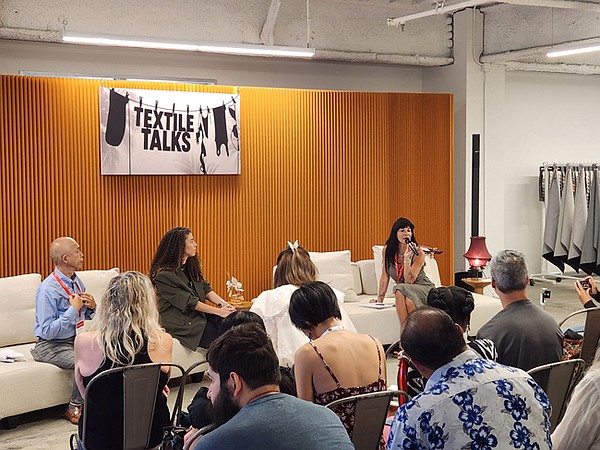
Texworld and Apparel Sourcing provided inspiration and education during the July 21–23 Los Angeles edition at the California Market Center, which featured educational sessions such as “From Innovation to Adoption: Scaling Next-Gen Bio-Based Materials From Innovation to Retail Reality”
TRADE SHOW REPORT
L.A. Sourcing, Textile Shows Provide Greater Options
As July wound down, Los Angeles welcomed a roster of apparel textile and sourcing shows across categories. Messe Frankfurt hosted its summer Los Angeles Texworld and Apparel Sourcing L.A. editions July 21–23 at the California Market Center in downtown’s fashion district to showcase supply-chain resources from textile providers to apparel manufacturers. Comexposium’s Interfilière Los Angeles launched as a colocated event with Texworld and Apparel Sourcing to provide supply-chain options in intimates, active and swim.
Preface Los Angeles hosted its summer event July 29–30 at Mica Studios in the arts district, partnering with consultancy firm Denim Dudes and denim-industry event Here|After for an intimate take on sourcing and supply-chain options.
Texworld and Apparel Sourcing Los Angeles provided variety to support attendees’ sourcing decisions, yet the shows are also popular for the calendar of Textile Talks education sessions. This year’s education schedule included topics such as “The AI-Powered Product Journey: Design, Production and Commerce in 2026,” “Weaving Tomorrow’s Narratives: Fall/Winter 2027/28 presented by Peclers Paris” and “From Innovation to Adoption: Scaling Next-Gen Bio-Based Materials From Innovation to Retail Reality,” which drew the attention of Kathirine Jameson, creative director of San Diego casual womenswear brand Liliai, who was interested in sourcing fabrics made with sustainable, natural fibers
“There is a lot of different information,” Jameson said. “You can source different types of things and it’s a one-stop place.”
Lavini Tang, a technical designer and owner of Los Angeles–based N49 Studio, Inc., was grateful for the opportunity to explore sourcing, factories and trims in a local setting.
“I found a factory and they have great prices to produce my styles and I found a trim company,” Tang shared. “We don’t have many options to really connect with international vendors. I am grateful they’re doing this show here. I don’t want to go to New York or Las Vegas.”
First-time exhibitor Monica Mazzucchelli of Moda Style represented Texlabel, whose focus is producing care labels. The need for accuracy and transparency has made the companies within this segment of apparel manufacturing crucial partners for designers and brands.
“There are new regulations and the Digital Product Passport is starting soon, so it’s becoming a reality for clients to know they have to be compliant with the information that they put on the care labels,” said Mazzucchelli. “The concern for the client is ‘Is my garment going to have the correct information?’ and ‘How do I know if that is right or not?’ We offer the service of making sure the labels are compliant for all the countries you’re going to sell in.”
The launch of Interfilière’s Los Angeles show drew attendees representing the intimates, active and swim categories in search of fresh materials and production partners. Searching for the perfect new fabric or a factory more aligned with a brand’s mission was top of mind for visitors, but the show also afforded opportunities to connect and collaborate.
“Our conference program explored the trends shaping the 2027/2028 seasons, featured a candid roundtable talk with leading West Coast designers on the evolving needs of today’s market and examined the growing demand for natural fibers and bio-based material innovations,” explained Kirsten Griffin, visitor-promotions director of Comexposium U.S.’s fashion division, “These conversations highlighted how creativity, technology and responsible sourcing are driving the future of fashion.”
According to Griffin, attendees were largely interested in circular materials, bio-based fibers, seamless technologies and specialty trims. Loulia Gotsis, a swim designer with Miken Clothing, which can be found at retailers including Macy’s, Nordstrom and Walmart, was looking for nylon and spandex.
“I am looking more for textures like crochet; a lot of jacquards—especially for swim, because they’re very easy to find for sweaters and tops but it’s a little harder for swimsuits,” Gotsis said. “I am trying to find some that potentially have a little bit of nylon because a lot of brands are trying to elevate their bikinis. I am going more for the texture and the content.”
Interfilière also gave Gotsis an opportunity to explore factory options. She notes that manufacturers in China stand out for swimsuit production, but there are additional factories in other regions that are starting to catch her attention.
“Keeping the relationship between China and other countries and the U.S. is important because there is talent overseas,” she said. “India and Bangladesh, too, but the quality in China is still excellent.”
At the Grandfine Textiles booth, exhibitor Kina Lee, global director of sales and marketing for the Guangdong, China–based textile manufacturer noticed attendees were attracted to neon, pastels and prints, while texture and raised patterns were ticking.
“A lot of people are coming and looking for swimwear,” said Lee. “They are still looking for texture in swimwear. For lingerie, everybody still likes softer and functional fabrics.”
Boutique sourcing show PREFACE returned to Los Angeles with event founder Betsy Franjola celebrating its 18th edition with a second collaboration with Denim Dudes and Here|After. Franjola noted the theme of the show was SEEDS, which need the correct conditions to flourish—similar to innovation. The same could be said of the partnership.
“Here|After and Denim Dudes bring deep denim expertise, cultural insight and a wonderfully engaged community. PREFACE brings a broader textile and supply-chain perspective,” Franjola said. “We share a belief that an industry event should offer more than a marketplace. It should create conversation, encourage curiosity and give people something meaningful to take back into their work.”
Many industry leaders supported the show through meaningful contributions. Aligning with the SEEDS theme, Eastman Naia participated in an installation featuring seed imagery printed on fabrics made with Naia fibers.
“We were thrilled to be part of the installation with Naia fabric hanging,” said Joy Gruver, Naia business development leader for the Americas. “The word is getting out, and the fact PREFACE partnered with Amy and Denim Dudes is amazing.”
Over the show’s two days, attendees were invited to participate in discussions to move the industry forward and find inspiration. Topics included “Denim Dudes Fall/Winter 2027/2028 Forecast,” “A Cutting, Not a Copy: AW27 Seasonal Trend” and “Heritage 2.0: From Preservation to Reinvention.” Show sponsor SFI sought to inspire attendees with its Vintage Denim Archive installation.
The show attracted serious denim and apparel professionals who yearned for connecting with their peers and engaging in enriching discussions.
“These trade shows are always great for connecting. I run into people I haven’t seen in years,” said Loren Cronk, co-founder, and head of operations and curation for The Denim Institute & Museum.
The show’s boutique feel was a welcome change from the enormous expo-style events that attract a larger, more varied group of attendees.
“After COVID-19, all the shows changed. We are looking for the premium show,” Wayne Chiang of Taipei, Taiwan’s 496 Fabric. “The really big shows have thousands of visitors, lots of mills from around the world. We need to be more focused on what we’re doing right now.”
Meeting in Los Angeles remains a priority for companies that want to help brands in the region set global trends.
“L.A. is important because this place is premium,” said Alihan Kesim, deputy general manager with Maritas. “A lot of brands—in Europe especially—follow L.A. brands.