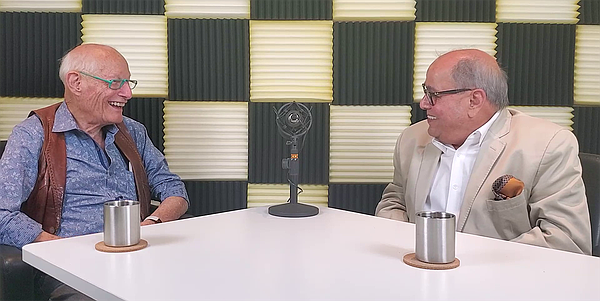
Walter Wilhelm (left) and Ram Sareen
TECHNOLOGY
The History Of CAD/CAM In The Apparel Industry
The history of the apparel industry has largely been documented through the companies that survived. Much less has been written by the individuals who actually created the technologies that transformed how apparel is designed and manufactured.
Walter Wilhelm is one of those individuals.
At 87 years of age, Walter recently shared with longtime friend and fellow industry pioneer Ram Sareen his personal recollections of the birth of CAD/CAM technology in the sewn products industry. Walter's firsthand account predates modern digital pattern making, automated cutting, and 3D product development, taking readers back to a time when none of these technologies existed.
Presented here is Walter's story, organized for publication while preserving his original recollections and perspective.
A Foreword from Ram Sareen
There are moments in life when an email becomes much more than a message.
Recently, I received a note from my dear friend, Walter Wilhelm. It immediately brought back memories of the remarkable people who built the technological foundation of our industry.
Walter is not writing as a historian looking back through research. He is writing as an engineer who helped create that history.
As our industry continues embracing Artificial Intelligence, Digital Twins, 3D product development, automation, and cloud technologies, it is important to remember where the journey began—and the extraordinary individuals whose vision made today's innovations possible.
Many of the pioneers from those early days are no longer with us. Their knowledge deserves to be preserved before it disappears forever.
It is my privilege to share Walter's firsthand account with the readers of California Apparel News.
Ram Sareen
Chairman-Founder, TUKATECH
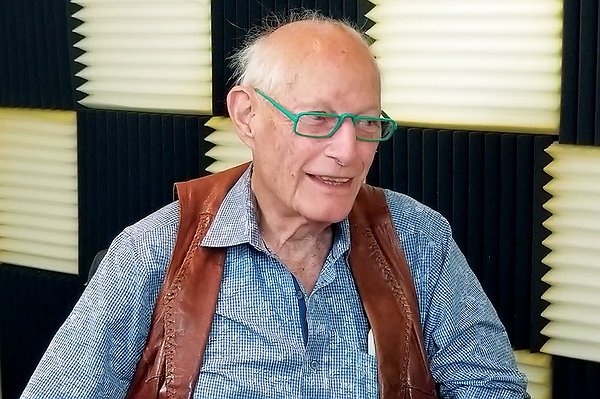
The History of CAD/CAM in the Sewn Products Industry
By Walter Wilhelm
Some months ago I suffered a computer crash and lost much of my historic information and many of my contacts.
One morning, quite unexpectedly, I woke up thinking about the early history of CAD/CAM technology in the sewn products industry.
As I reflected on those years, another thought crossed my mind.
Ram, I think you may be the last leader from those early days who is still actively shaping this industry.
Whether that is entirely true or not, it prompted me to remember how this remarkable journey actually began.
Before CAD/CAM
Around 1970, there simply was no CAD/CAM technology for the apparel or footwear industries.
The first significant effort began when Genesco, under Frank Jarman, together with Burlington Industries, approached Hughes Aircraft with a research project to develop an automated low-ply fabric cutting system.
The assignment was ambitious.
Hughes engineers investigated more than forty different cutting technologies, including:
- Laser cutting
- Waterjet cutting
- Ultrasonic cutting
- Rotary blade cutting
- Reciprocating blade cutting
- Cryogenic freezing using liquid nitrogen or liquid oxygen
Some of the concepts were extraordinarily creative. One involved freezing fabric solid, manually etching the pattern outlines into the frozen material, and then flexing the fabric so the pattern pieces would literally "pop out."
After extensive research, Hughes concluded that laser cutting offered the greatest technical promise.
Genesco subsequently awarded Hughes a contract to build a laser cutter for Greif Menswear in Baltimore.
At the time, I was working in Hughes' Aerospace Division managing the environmental laboratory supporting the Surveyor Moon Program. Hughes transferred me into the Industrial Products Division to lead development of the laser cutting project.
The commercial selling price of the machine was approximately $625,000—a considerable investment in the early 1970s.
Technically, the machine worked.
Commercially, very few were sold.
Creating Digital Cutting Instructions
Ironically, building the cutter proved easier than creating the digital information needed to operate it.
Greif manually arranged pattern pieces on large rolls of paper, scanned those layouts, digitized the images, and then transmitted the information to the laser cutter.
By today's standards it sounds primitive.
At the time, it represented one of the first attempts at digital manufacturing in apparel.
The Birth of Digital Pattern Engineering
Several companies soon began pioneering computerized pattern grading and engineering.
Among them were:
- Autographics (Howard Wohlmuth and his sons Louis and Mickey)
- GTC in New York
- CAMSCO in Dallas, founded by Ron Martell and Elmer Leslie
- Lectra, founded by Jean and Bernard Etcheparre in Bordeaux, France
Hughes entered into an exclusive agreement with Autographics to develop computerized marker making (nesting) technology for the laser cutter.
The Early Cutting Systems
At that time, commercially available automated cutting technology came primarily from two companies.
Gerber Scientific eventually became the industry standard after acquiring Autographics' AM-1 grading and marker technology.
Cincinnati Industries also entered the market but ultimately withdrew after only limited commercial success.
Europe Joins the Revolution
During the late 1970s and early 1980s, the industry expanded rapidly.
Investronica, supported by Spain's El Corte Inglés, entered the CAD/CAM marketplace.
CAMSCO was acquired by Sulzer of Switzerland.
Ron Martell and Elmer Leslie then established Microdynamics, focusing on sewing automation through the AutoSew system.
When I resigned from Hughes in 1980 to join Ron and Elmer, Hughes no longer had personnel who truly understood the fashion industry.
Before leaving, Hughes asked me to oversee the sale of its laser cutting business.
The division was eventually sold to 3M.
To the best of my knowledge, 3M never commercialized the laser cutter.
The People Who Changed an Industry
Technology often receives the recognition.
The people behind it frequently do not.
When I think back over more than fifty years, the list of true pioneers is surprisingly short.
- Joe Gerber
- Ron Martell
- Jean Etcheparre
- Ram Sareen
Jean and I remained friends for many years. I remember him visiting our home, sitting on the floor, playing his guitar, and reciting poetry.
Today, I believe Ram may be the last of those pioneers still actively leading innovation in our industry.
I hope he continues until he is 100 years old.
Looking Forward
By Ram Sareen
Walter's reflections are more than personal memories—they are living history.
Our industry has progressed from manual drafting tables to digital engineering platforms, from mechanical grading to Artificial Intelligence, from paper markers to cloud-based collaboration and virtual product development.
Yet every advancement rests upon the work of those who dared to imagine something better decades ago.
Future generations will continue to build technologies we cannot yet imagine.
Hopefully, they will also remember those who made their innovations possible.
Walter, thank you for documenting a chapter of history that deserves to be preserved.
About Walter Wilhelm
Walter Wilhelm is one of the early pioneers of CAD/CAM technology for the sewn products industry. His career includes leadership roles at Hughes Aircraft, where he directed development of one of the industry's earliest laser fabric cutting systems, and later at Microdynamics, advancing automation technologies for apparel manufacturing.
About Ram Sareen
Ram Sareen is Chairman-Founder of TUKATECH and has spent more than four decades advancing digital engineering, CAD/CAM, 3D product development, automation, and intelligent manufacturing technologies for the global sewn products industry.