Functional Fabric Fair
ACTIVE INNOVATION
Active Innovation on Display at New York Functional Fabric Fair
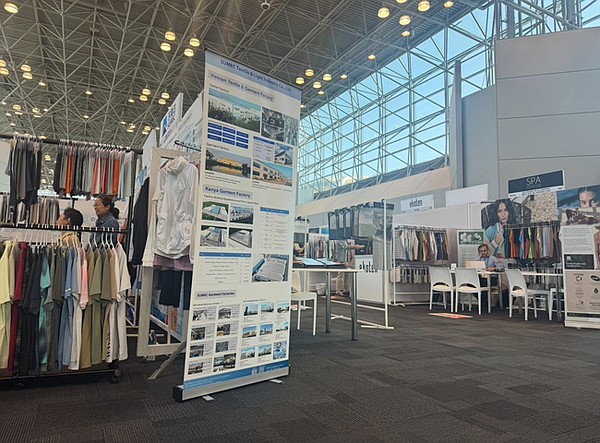
The Functional Fabric Fair at the Javits Center has become a core gathering for the textile industry since its start in 2018. The New York show, held July 7–9, focused heavily on athletic lifestyle, swimwear and lingerie—the exact kinds of materials sought after by major activewear brands such as Alo Yoga.
Steve McCullough, event vice president and show management lead, noted: “The show is born from a fabric mind, not a trade-show mind.” That perspective was clear across vendors, including yarn suppliers, textile mills and product-development tech companies.
Performance-fabric suppliers
The SoCal Textile Group represents three distinct Taiwanese operations: Rex Fabrics, Victorytex and Eclat. Managed by sales rep and owner of the SoCal Textile Group Jay Wetherald, they run their operations out of a permanent showroom in L.A.’s Cooper Design Space, focusing heavily on hands-on customer service.
Each entity has a specific role. Victorytex focuses on 100 percent Taiwan-made woven fabrics ranging from lightweight to heavyweight styles used mostly in golf and running gear. Eclat is a massive vertical mill that makes its own fabrics, supplying global brands such as Under Armour. “Quality sets Eclat apart,” Wetherald said, pointing to its 50 years of manufacturing polyester, nylon and Tencel. Meanwhile, Rex Fabrics operates as a converter, working directly with outside mills to customize garment solutions rather than weaving the textiles itself.
Burlington highlighted synthetic wovens and split its production between domestic plants in North and South Carolina and overseas facilities, with its main team based in China. It supplies a wide spectrum of clients, from outdoor brands like L.L. Bean to mass retailers like JCPenney, focusing on multi-seasonal fabrics that give customers the “most bang for their buck,” according to account manager Morgan Price. All of its fabrics use recycled content, and it utilizes its own proprietary bio-based moisture finish to meet market demand.
Bringing an Italian perspective was Carvico, located about an hour outside of Milan. It specializes in stretch fabrics designed for swimwear, underwear, intimates and activewear, keeping all of its production in Italy. For Carvico, “Italian style means offering extensive color cards and highly curated trend books to help designers plan their lines,” said Lorenzo Ghezzi, sales representative. Because the U.S. is a major market for the company, it relies on strict quality control and reliable service to keep its edge.
Bio-based materials and sustainability
Eco-focused fabric tech was highly visible with Covation/Sorona. Formerly owned by DuPont before the bio-based division was sold off, the brand marked its 25th anniversary last September. It uses industrial, non-edible dent corn grown in Iowa, Indiana and Illinois to create polymers and yarns, selling them down the line to fiber spinners and athletic brands.
Matthew Cole, working on the brand side, introduced its newest commercial release: Xatryx. Launched this year, Xatryx is a bio-based spandex alternative made by fermenting leftover corn cobs. This process creates the specific molecule responsible for the fabric’s stretch, offering a plant-based alternative to traditional elastane for sportswear and sleepwear.
CiCLO addressed the problem of synthetic waste. With synthetic textiles accounting for roughly 35 percent of ocean microplastics, CiCLO’s ten-year-old technology offers a practical fix. By adding a 2 percent CiCLO ingredient to recycled plastic bottles or virgin polyester during production, “they have enabled a polyester to behave like a natural fiber when it ends up in a natural environment,” said Vice President Cheryl Smyre. “This allows synthetic fibers to biodegrade in seawater or soil within 2.5 to 5 years.” CiCLO has backed up its science with a technical white paper and extensive long-term biodegradation studies, selling the technology directly to a global network of certified fiber manufacturers.
Trims and development tech
The small details were covered by Shindo USA, a branch of Shindo Japan, which has been around for 55 years. Shindo has had a New York presence since 2002 alongside showrooms in Tokyo, Milan, Paris, Los Angeles and New York. It specializes in ribbons, trims, laces, suede tapes and stretch items necessary for intimate apparel and upscale clothing, working with brands including Brooks Brothers and Alexander Wang. It offers custom item dyeing with low wholesale minimums and a fast 5-to-7-day turnaround time.
Behind the scenes of the design process, OnBrand PLM stood out at the show. Account Executive Tanner Randall demonstrated how its product life-cycle management software helps design teams track samples and manage workflows. Built around activewear brands such as Title Nine and Evelyn & Bobbie, OnBrand has been around for just over four years.
“OnBrand uses AI to show you quick visual mockups of your sketches, and you can instantly apply a fabric. OnBrand can be quickly learned in just two to four weeks—or for those who are ambitious, just a single day—compared to other PLM software, which can take months to adapt to,” explained Randall.
This edition of Functional Fabric Fair proved that the “fabric mind” driving the industry is focused on making performance gear both highly functional and environmentally conscious. From biodegradable polyester and corn-based stretch fibers to AI-driven workflow software, the innovations on display are reshaping how we construct the clothes we live and move in.