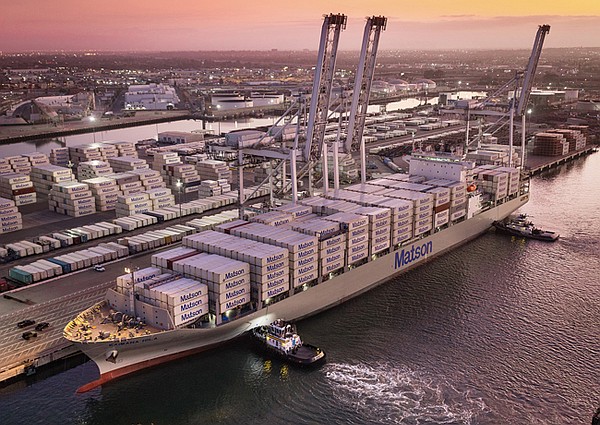
Photo by Matson Logistics Tim Rue
IMPORT/EXPORT
Leading Through a Logistics Lineage: Q&A With Matson Logistics’ Michael T. Johnson
The Middle East conflict has increased dangers for vessels and driven up costs since the beginning of the year, and Matson Logistics is supporting its customers as they navigate these uncertain conditions. Matson Logistics’ nearly 40-year-long history as a subsidiary of 150-year-old ocean-transportation giant Matson, Inc. has grown the company into a global operation.
Its services include transportation brokerage, long-haul and regional highway FTL/LTL transportation, intermodal Class I rail services with a dedicated fleet, bicoastal U.S. warehousing and distribution, and global services supporting the supply chain throughout Asia, South Asia, the Middle East, Europe and Africa. The Matson Logistics mission also includes sustainability efforts and environmental stewardship plus philanthropic support for the communities where it conducts business through Matson Giving.
California Apparel News spoke with Michael T. Johnson, vice president of supply chain at Matson Logistics, to discuss how the company has grown and continues to evolve to support its clients through global services.
California Apparel News: What are some of the key components of Matson Logistics’ evolution since you joined the company?
Michael Johnson: When I joined Matson Logistics, it was primarily a domestic logistics service. Matson Logistics was established in Asia offering freight-forwarding business, which is providing local origin, pre-vessel services in China for the Matson Navigation customer base.
Early 2013 was the kickoff for the Matson Logistics Expedited LCL solution, built on the backbone of Matson Navigation CLX’s fastest transpacific service in the industry from Shanghai to L.A. We were consolidating LCL shipments for Matson customers who were looking for less than a container-load expedited solution. We’ve grown it significantly and expanded it significantly.
Our solution is a hub and bespoke operation all through China. We bring cargo into Shanghai and ship to Long Beach on the Matson CLX, not CLS, service. In that time frame of 2013, we also expanded our expedited solution offering a weekly China-to-Honolulu service. Since that time, we have also expanded into Vietnam and Cambodia offering expedited services from Phnom Penh, Haiphong and Ho Chi Minh to Shanghai.
We are in the throes of launching an expedited LCL from Thailand in the next few weeks. We have also established a new full-container service from Bangladesh to L.A. with a 35-day transit time.
CAN: At nearly 150 years old, what are the core tenets and values that continue to support Matson?
MJ: We built our logistics solutions to accommodate apparel importers and accessory importers that don’t necessarily have the wherewithal to make significant ERP investments and expanding those ERP solutions to manage their supply chains. We take on a lot of that responsibility within Matson Logistics.
We do a lot of systems design for our customers, and we build custom solutions to deliver requirements they need rather than building internally. With that, we’re going after the importer that does 500–5,000 containers a year, not pursuing the large importers in the 100,000-containers-a-year category. If we tried to build solutions for that it would completely disenfranchise our existing customer base. It would take away from that hands-on approach. Matson Logistics does a lot of boutique work for customers looking for expedited and efficient solutions.
We want our customers to grow their businesses without having to grow staffing. We build a lot of IT development project work for our customers that allows them to be more economical and focus on growth of sales and sourcing opportunities.
CAN: Matson is engaging in a fleet renewal program—how will this support clients to navigate around modern challenges?
MJ: The new ships are being built in Philadelphia. The first one will be christened in the fourth quarter of 2026 and put into service in the first quarter of ’27. There will be two behind that one. They’re all capable of running consistently over 23 knots and about 3,400 TEU-sized vessels built for speed and built for our customers in that transpacific trade.
CAN: How are you helping customers navigate today’s challenges, including the Middle East conflict?
MJ: We’ve been growing as our customers have shifted their sourcing patterns, so we’re ahead of the game. Sourcing is usually six to eight months ahead of delivery, so right now we’re moving Back-to-School, Early Fall and Christmas. We’ve moved with our customers’ sourcing. As a supply-chain logistics manager, we are directly engaged with the P.O.s that are being issued by the production groups of these importers. We’re managing their entire supply chain from P.O. issuance through to the production cycles. We have complete visibility of the production. We’ve expanded through the years into places like Vietnam, Cambodia, Bangladesh, India, Pakistan, Malaysia, Thailand, Turkey, Italy, Egypt and Africa—many non-traditional Matson locations.